
Tree work on the Springfield Plateau
Tree Service in Springfield, MO
Removal, pruning, stump grinding and storm cleanup, planned around ice, Ozarks wind, rocky ground and City Utilities lines.
- We come out and look before we price, anywhere in Springfield and nearby towns
- Every task on the quote has its own line
- Haul-off spelled out on the quote
Ice Storms, Oak Country and Rock Under the Lawn
Tree service in Springfield means working with weather that swings hard. The city gets about 44.7 inches of precipitation a year, around 40 days at 90 degrees or hotter, and a Forbes list once named it the U.S. city with the most varied weather. For the trees in your yard, that means summer drought stress, spring thunderstorms that drop big limbs, and the occasional winter glaze that bends everything toward the ground. Most of the work we do comes down to three questions: is this tree sound, what will it hit if it fails, and what is the safest way to cut it back or take it down on this particular lot?
The ice storm people still talk about
In January 2007, the National Weather Service in Springfield measured about an inch and a half of ice in parts of the Ozarks. At the peak, more than 75,000 City Utilities customers lost power, some for weeks, and about 330 power poles had to be replaced around the city. Ice loads punish long horizontal limbs, trees with tight V-shaped forks, and anything with old decay. More recently, the severe storms of April 29, 2025 caused so much tree damage across Springfield that the city waived its brush disposal fees. Pruning weight off risky limbs and checking weak unions before a storm costs a fraction of what cleanup does afterward.
Oaks, cedars and the trees people planted
Left alone, the uplands around Springfield grow oak and hickory. USDA soil and vegetation surveys for this part of the plateau list white oak and black oak as the dominant trees, with post oak and shagbark hickory mixed in, and eastern red cedar is everywhere along fence rows. Older neighborhoods such as Midtown, Phelps Grove and Rountree add silver maples, sycamores and pines that are now very large. Newer subdivisions on the south and west sides were planted heavily with Callery pears, which grow fast, split in wind and spread into fields. Each of these trees fails in its own way, and an honest estimate starts with knowing which one you have.
Three local problems: ash borer, pine wilt and pears
The Missouri Department of Agriculture confirmed emerald ash borer in Greene County in 2018, including a trap site on a Greenways trail in southwest Springfield. The Missouri Department of Conservation says the beetle kills more than 99 percent of the ash trees it attacks within three to four years. Pine wilt, spread by sawyer beetles, kills Scots pines and Austrian pines, often within a season, and the Missouri Botanical Garden advises removing infected trees quickly and burning or burying the wood instead of using it as mulch. Callery pears are not a disease, but they come apart in storms; a Springfield arborist told KY3 that fallen pears have smashed cars and torn gutters off houses.
Wires, City Utilities and your service line
City Utilities clears trees along its own lines and targets about 15 feet of clearance from primary wires. The line from the pole to your house is a different matter: CU says keeping limbs off that service line is the property owner's job. If the tree is near a primary line, Missouri's Overhead Power Line Safety Act bars anyone not authorized from coming within 10 feet of it, so we stop and work with CU's Tree Management office first. Outside the city, Nixa Utilities, Liberty and other providers set their own rules.
Rocky ground and karst
Springfield is built on Mississippian limestone. The soils over it on many uplands are full of chert gravel and cobbles, and the U.S. Geological Survey has mapped about 2,500 sinkholes in Greene County's karst. For tree work, that means stump grinders hit rock, roots run shallow and wide, and heavy equipment needs a careful look at the ground before it rolls across a yard. We plan the access path as part of the estimate.
Where the wood goes
The City of Springfield's Yardwaste Recycling Center near Brookline takes brush for a small fee, but limbs must be cut to 10 feet or shorter and no thicker than 10 inches; bigger wood and root balls go to the Springfield Sanitary Landfill. Your quote says whether we chip and haul everything, leave logs for firewood, or leave chips for mulch. City Utilities also leaves free wood chips for the public at 740 N. Belcrest if you need more.
What every estimate covers
- A walk around each tree: species, lean, dead wood, cracks, decay and root damage
- The targets below it and the path a crew would use to reach it
- Wires, and whether City Utilities or another provider has to be involved
- Pests worth checking for: ash borer exit holes, browning pines, split pear limbs
- How brush, logs, chips and the stump will be handled
- One written price per tree, with nothing added unless you approve it
Common Questions
How much does tree service cost in Springfield, MO?
It depends on the tree's size, its condition and what is under it. Homeyou's 2026 Springfield figures put a medium tree removal at about $517 to $703 and pruning at about $375 to $525. LawnStarter lists Springfield averages of roughly $301 for a small removal and $1,729 for a large one. We give you a written price after seeing the tree.
Do I need a permit to cut down a tree on my property in Springfield?
For an ordinary tree on a private residential lot, we have not found a general city removal permit. Springfield's Land Development Code does protect trees that were counted toward an approved development landscape plan, and many subdivisions have HOA rules. If the tree stands along the street, ask the city's Citizen Resource Center at (417) 864-1010 before work starts.
Will City Utilities trim a tree that is touching the wire to my house?
Generally not. City Utilities says the property owner is responsible for keeping limbs away from the service line, the wire from the pole to the house. CU will disconnect and reconnect that line for free with two business days' notice at (417) 863-9000, so it can be pruned safely. Trees near primary lines are handled through CU's Tree Management office.
My ash tree looks thin at the top. Is it emerald ash borer?
It may be. Emerald ash borer was confirmed in Greene County in 2018, and early signs include a thinning crown, woodpecker damage that leaves pale patches on the bark, and small D-shaped exit holes. The Missouri Department of Conservation suggests removal for trees that have lost more than half their leaves and branches. We can look at it and tell you which side of that line it is on.
Why did my pine turn brown all at once?
In Springfield, a Scots or Austrian pine that browns quickly in summer or fall is often a pine wilt case. The disease is carried by sawyer beetles and usually kills the tree. The Missouri Botanical Garden recommends removing infected pines promptly and burning or burying the wood rather than chipping it for mulch, so the beetles cannot breed in it.
What can I do with the brush and logs?
We can chip and haul everything, leave logs cut to firewood length, or leave chips for your beds. If you haul brush yourself, the city's Yardwaste Recycling Center takes limbs up to 10 feet long and 10 inches thick for a small fee per load. Larger wood and root balls go to the Springfield Sanitary Landfill.
Is there a tree company near me that will look at a tree before giving a price?
Yes. Every estimate we give in Springfield and the nearby towns starts with a visit to the tree. A price given over the phone cannot account for wires, fences, slope or decay, and those are what change the cost. Call or send the form with photos to set up a time.
Should I remove my Bradford pear?
Bradford and other Callery pears tend to split at their crowded forks in wind and ice, and they spread into fields and woods. If yours already has a split or sits over a roof or driveway, removal is usually the sensible call. The Missouri Department of Conservation and the Missouri Invasive Plants Council have run a buyback that trades proof of removal for a free native tree.
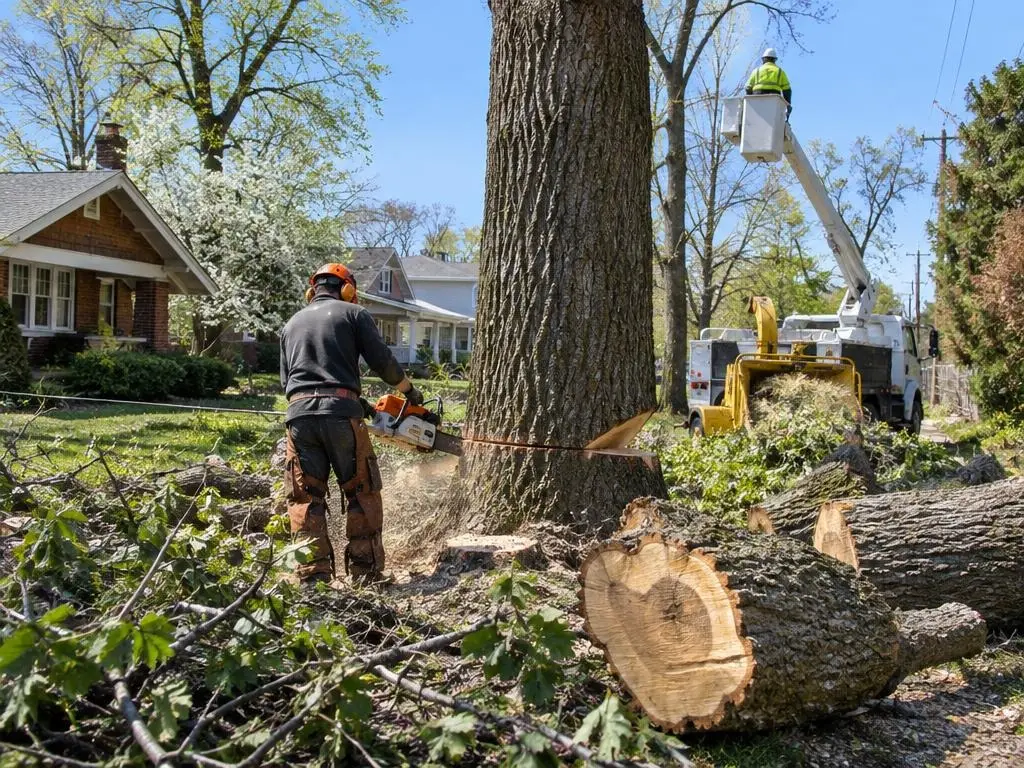
Tree Services in Springfield
Six kinds of work cover nearly every tree problem we see on Springfield-area properties, from a single dead limb to an ash that has to come down.
Tree Removal
Dead, dying, storm-cracked and unwanted trees taken down in pieces, with the wood handled the way you want.
Learn more →Tree Trimming & Pruning
Dead wood out, weight off long limbs, clearance over roofs and drives, all cut to ANSI A300 practice.
Learn more →Stump Grinding
Stumps ground below grade, with surface roots, rock and chips dealt with as agreed.
Learn more →Emergency Storm Tree Service
Trees and limbs on roofs, cars, fences and driveways cut off and cleared after ice, wind and thunderstorms.
Learn more →Ash Tree Removal
Ash trees hit by emerald ash borer checked, compared against treatment, and removed before they turn brittle.
Learn more →Cabling & Bracing
Steel or synthetic cables and rods that add support to split-prone forks and heavy limbs on trees worth keeping.
Learn more →Where You Will Find Our Crews
Springfield is the center of our service area, from the older streets around Drury and Missouri State to the newer subdivisions off James River Freeway. From there we work out across Greene County and into Christian County: Battlefield, Republic and Brookline to the southwest; Nixa and Ozark to the south; Rogersville and Strafford to the east; and Willard, Fair Grove and Ash Grove to the north and west. The whole area shares the same ice and thunderstorm risk and the same rocky soil. What changes from town to town is the electric provider, how brush is collected or dropped off, and how many large old trees stand close to houses. Each area page covers what we know about that place.
- Tree Service in Springfield, MO
- Tree Service in Nixa, MO
- Tree Service in Ozark, MO
- Tree Service in Republic, MO
- Tree Service in Battlefield, MO
- Tree Service in Brookline, MO
- Tree Service in Willard, MO
- Tree Service in Strafford, MO
- Tree Service in Rogersville, MO
- Tree Service in Clever, MO
- Tree Service in Sparta, MO
- Tree Service in Highlandville, MO
- Tree Service in Fair Grove, MO
- Tree Service in Ash Grove, MO
- Tree Service in Walnut Grove, MO
- Tree Service in Pleasant Hope, MO
- Tree Service in Marshfield, MO
- Tree Service in Fremont Hills, MO
- Tree Service in Billings, MO
- Tree Service in Marionville, MO
- Tree Service in Fordland, MO
- Tree Service in Seymour, MO
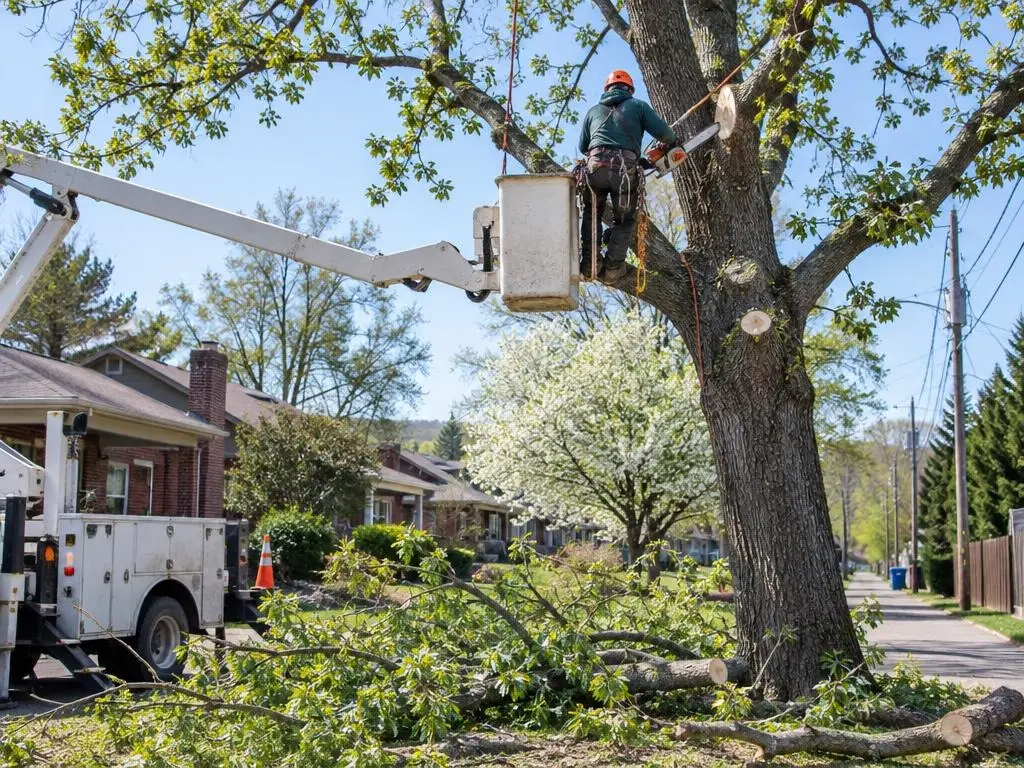
Why Homeowners Call Elite Tree Service Springfield
A price you can read
Each tree gets its own line: the work, the cleanup, the stump and the cost. You can approve one tree and hold off on another.
Wires sorted out first
We tell you up front whether a tree touches the service line you are responsible for or a primary line that City Utilities has to handle.
Local pests named plainly
Ash borer damage, pine wilt and storm-prone pears are pointed out on the visit, with removal and keep-it options compared honestly.
Yards treated with care
On soft or rocky ground we plan the equipment path, lay protection where needed and lower limbs over gardens instead of dropping them.
Schedule a Free Tree Visit
Free on-site estimates in Springfield and across Greene County, with a written price for each tree.